
Recent developments at McKinsey & Company show how quickly AI is becoming part of the daily mechanics of professional services.
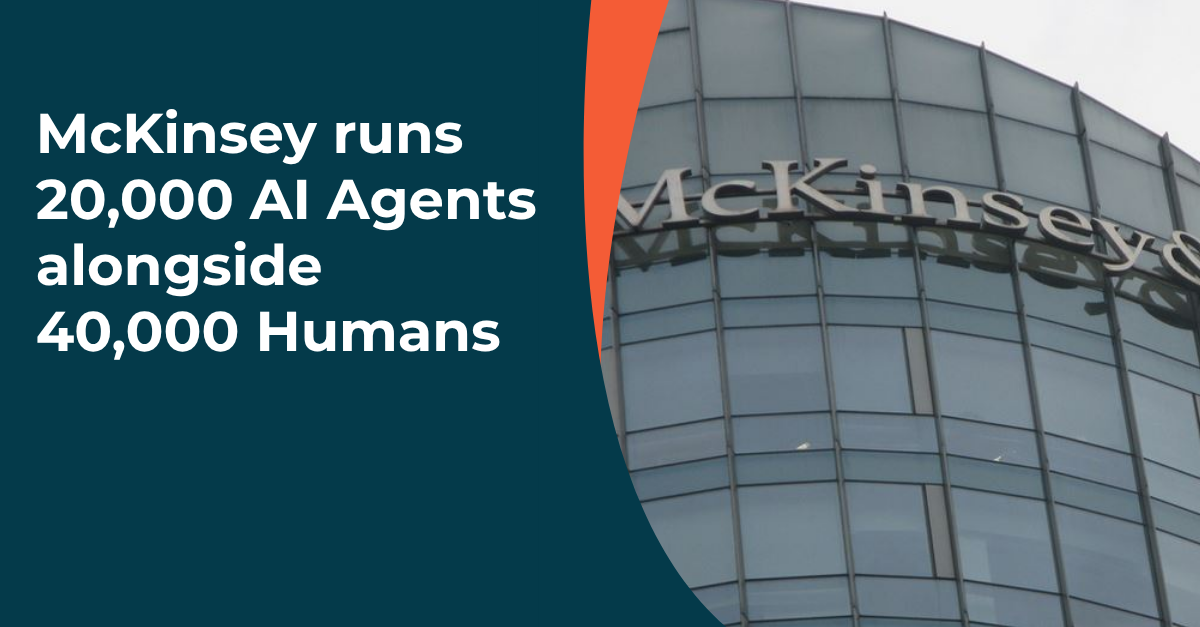
Earlier this year, McKinsey’s global managing partner, Bob Sternfels, told Harvard Business Review that the firm now describes its workforce as 60,000 strong, made up of 40,000 humans and 20,000 AI agents. He added that McKinsey expects every employee to be enabled by at least one agent within 18 months.
McKinsey has been building Lilli, its internal generative AI platform, since 2023. The firm says Lilli helps colleagues search, synthesise and apply McKinsey knowledge more effectively. Since its firmwide rollout in July 2023, McKinsey says 72% of the firm has been active on the platform, with colleagues reporting up to 30% time savings when searching and synthesising knowledge.
Recruitment is now part of the same conversation. According to reporting from the Financial Times and The Guardian, McKinsey has piloted an AI assisted assessment for some graduate candidates, asking applicants to work with Lilli during final round exercises. The reported focus is on judgement, reasoning and the ability to use AI as a thinking partner, rather than advanced technical AI knowledge.
Taken together, these examples show that AI adoption is becoming a practical workforce reality. It affects how people search for information, how teams structure work, how decisions are prepared and how future talent is assessed.
For businesses, AI value does not come from adding tools on top of existing processes. It comes from building the foundations that allow people to use those tools confidently, securely and consistently.
Stanford’s 2026 AI Index found that organisational AI adoption has reached 88 percent, which makes the next challenge less about access to AI and more about meaningful implementation.
📰 Sources: