
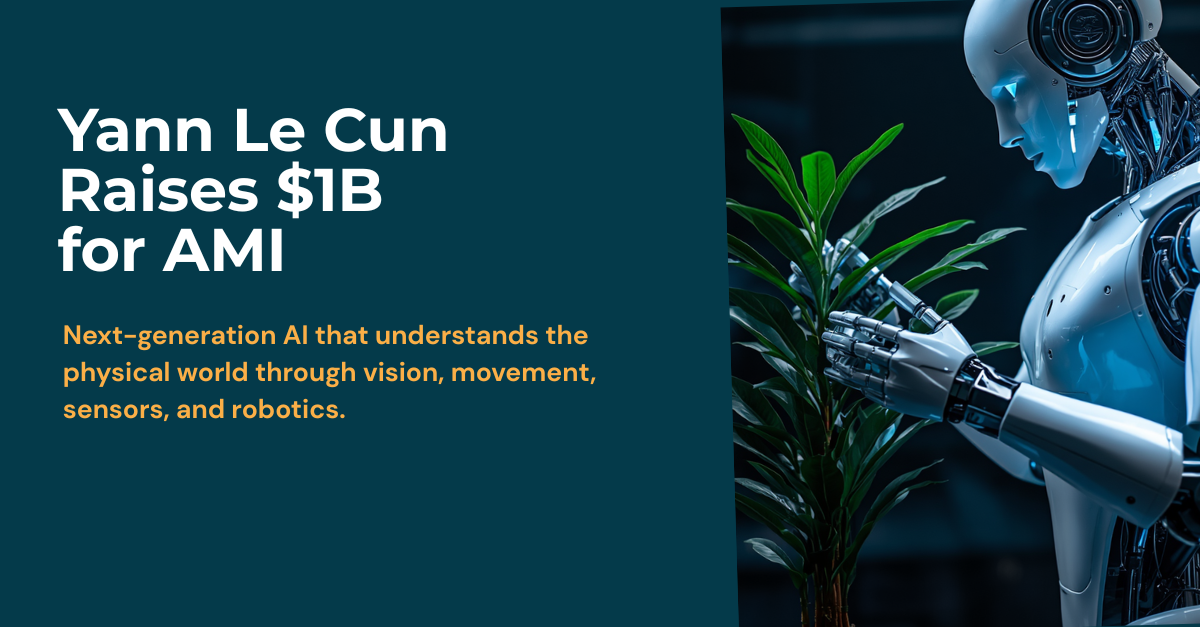
Yann LeCun, Turing Award winner, former chief AI scientist at Meta, and one of the three researchers credited with inventing modern deep learning, announced that his new startup AMI (Advanced Machine Intelligence) had raised $1 billion in its first funding round.
The investors are not small names. Toyota, Nvidia and Samsung all took part. So did former Google CEO Eric Schmidt and Amazon founder Jeff Bezos. AMI was already valued at $3.5 billion before the round closed. But the money is almost secondary to what LeCun is actually building and why.
LeCun has been one of the most consistent and credible critics of the direction mainstream AI has taken. His argument is not that large language models like ChatGPT are useless. It is that they are fundamentally limited.
LLMs are extraordinary at processing and generating text. But they do not understand the physical world. They cannot reliably reason about cause and effect. They cannot watch a video of a glass falling off a table and predict what happens next. They learn from language, not from experience.
LeCun’s view is that this is a ceiling and AMI is his attempt to build something beyond it.
AMI is developing what LeCun calls “world models”, AI systems designed to understand the physical world in the way humans and animals do. Rather than processing text, these systems would process images, movement, physical interactions and environmental data, building a genuine internal model of how the world works.
Within three to five years, AMI aims to produce what LeCun describes as “fairly universal intelligent systems” capable of being applied to almost any task requiring an intelligent machine including autonomous driving and robotics to medical diagnostics and industrial systems.
AMI’s work builds directly on LeCun’s research at Meta into a new AI architecture called JEPA (Joint Embedding Predictive Architecture). He described it plainly: “It’s a direct continuation of that project.”
The company is headquartered in Paris with offices in New York, Singapore and Montreal. French President Emmanuel Macron welcomed the announcement publicly, writing: “Yann LeCun is turning a new page in artificial intelligence. This is the France of researchers, builders and the bold.”
If LeCun’s vision succeeds, the implications for how intelligent systems are built and deployed in business would be profound.
Today’s AI tools, including most of the enterprise applications your business is already using or evaluating, are built on LLM foundations. They are powerful within their constraints. But those constraints are real. They hallucinate. They cannot reliably reason over complex, multi-step physical processes. They struggle with anything that requires genuine understanding of context beyond language.
A shift toward world models would change what AI can actually do inside a business, not just what it can say. It would open new possibilities in manufacturing, logistics, healthcare, robotics and any domain where physical reality matters more than language.
This is still a five-year vision. But the $1 billion raised, and the calibre of the investors and researchers involved, indicates that this is not a fringe idea. It is the next serious frontier.
📰 Sources: